Category: Uncategorized

On Tuesday, October 23, President Trump signed the America’s Infrastructure Act of 2018, which contained key provisions of the NOWRA Act. This is a major milestone for NOWRA, as this marks the first legislation it has successfully passed.
The legislation President Trump signed contains the following provisions from the NOWRA Act:
- Information Clearinghouse. EPA is directed to set up a technology clearinghouse on the cost-effectiveness of alternative wastewater technologies, especially onsite/decentralized wastewater treatment.
- Disseminate Information to Local Governments. EPA must share information about the cost-effectiveness of onsite/decentralized wastewater treatment with local governments and non-profits seeking federal funding.
- Report to Congress. One year from now (and every three years thereafter), EPA must tell Congress how well it has met the first two objectives and also describe what other actions it has taken to increase deployment of onsite/decentralized treatment.
Ironically, NOWRA’s Lobbying Board of Governors was in the middle of a meeting at the Onsite Wastewater Mega-Conference when the news crossed the wires that President Trump has signed the legislation. It was somehow fitting that they were among the first to receive the news, as it marked the climax of a nearly two year effort by the group to get the NOWRA Act introduced in Congress and passed.
The legislation is a significant victory for the association and the industry. NOWRA President Jim Bell said, “This is a big win for NOWRA and for our industry. Requiring EPA to develop information about the cost-effectiveness of onsite/decentralized treatment, and to share it with governments seeking federal wastewater funding will help level the playing field and enable decision-makers to better understand the benefits of our industry’s technologies. There is much more we need to do for our industry, but this is a very good start.”
The requirement that EPA must report back to Congress on what it’s done to increase the use of onsite/decentralized technology is important also. Tom Fritts, who serves as the chair of the Lobbying Board of Governors, noted, “this requirement will help keep the agency focused on how they can help more onsite systems to be deployed. I know that Members of our Congressional Decentralized Wastewater Recycling Caucus will be interested in the results and the extent to which their efforts have produced measurable growth in use of our industry’s technologies.”
A presidential signature on the bill was never in doubt, as the legislation passed both the House of Representatives and the Senate by near unanimous margins. In fact, even before the bill was signed into law, Senator Ben Cardin (D-MD), recorded a video message which was played at the state of the 2018 Onsite Wastewater Mega-Conference. He thanked NOWRA for its efforts and offered congratulations on the organization’s efforts to make this legislation happen. Sen. Cardin is the Ranking Member of the Senate’s Environment and Public Works Committee, the committee which oversees all water-related legislation.
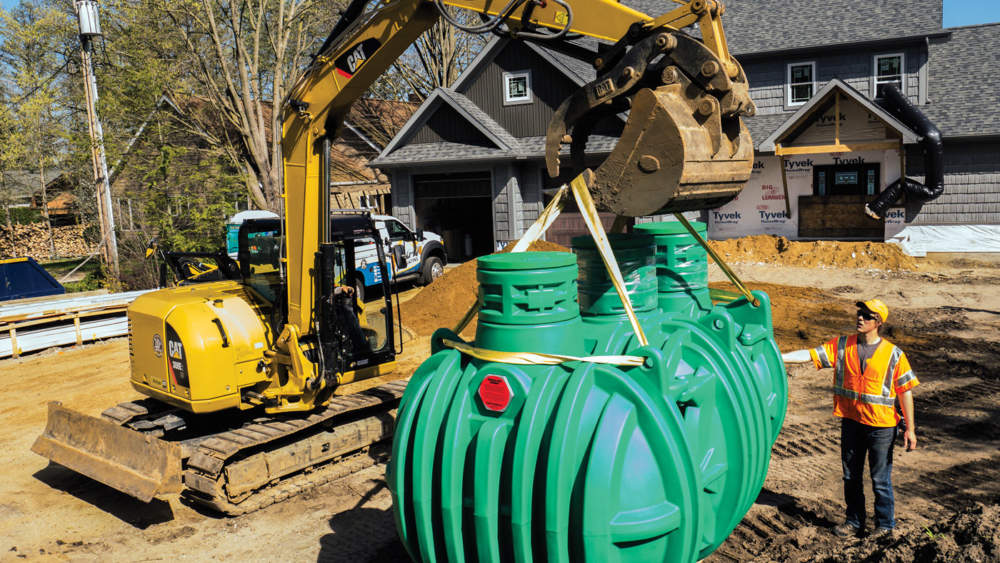
A homeowner needed help choosing wastewater systems for a lakefront estate. Dervin Witmer, owner of Dig-It Excavating in Cassopolis, Michigan, recommended a Norweco residential wastewater treatment system.
The project involved tearing down an old cottage and building a new, larger, four-season home on a lot right beside a lake. The owners had two goals for their wastewater system.
“One was environmental: They wanted to keep the lake clean and not contribute to the algae problem. But they also wanted alternative technology because of the space they had available,” Witmer says.
When the home was first proposed to the county, the design called for a standard wastewater system. There was a 1,500-gallon septic tank, a 500-gallon dosing tank, and an 800-square-foot drainfield in a sand mound built up to give adequate separation from the 12-inch seasonal water table.
Then came the twist that brought the job to Witmer. After the house was up, the contractor discovered a neighbor’s well had not been included in the permit information. Setback requirements left no room for the conventional system in the original design. That’s when Witmer’s friend called.
Witmer suggested the Norweco Singulair Green. It is a single tank, and with other changes to the home, the drainfield could be reduced to 600 square feet.
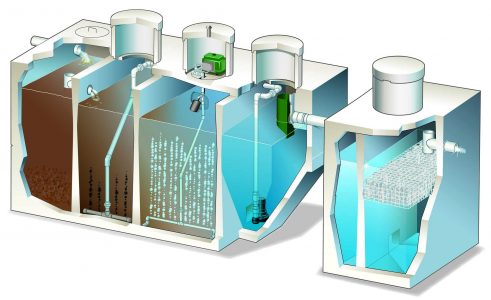
The Hydro-Kinetic Model 600 FEU (flow equalized upflow) wastewater treatment system from Norweco has been NSF Standard 40 and 245 certified. The residential wastewater treatment system passed two consecutive back-to-back tests without performing routine maintenance for 12 months.
During the 12-month testing period, the system achieved effluent results of 2.0 mg/L CBOD, 2.0 mg/L TSS and 7.9 mg/L Total Nitrogen. The effluent quality is ideal for installations where exceptional treatment and field sampling are mandated by regulation.
Flow equalized liquid from the clarifier enters the Hydro-Kinetic filter where it flows downward and is evenly distributed beneath filtration media. The liquid then travels through the proprietary attached growth filtration media where the final treatment takes place. The non-mechanical flow equalization device guarantees all incoming wastewater is fully treated, regardless of heavy use periods.
The system includes a Model A100 air pump, which maximizes operational efficiency and increases service life. Multiple air pump mounting locations are available. The Model SD103 recirculation pump features a 1/3 hp electric motor securely mounted in an oil-filled, watertight, corrosion-resistant housing with lubricated ball bearings to assure long life. The pump features a 2-inch discharge connection.
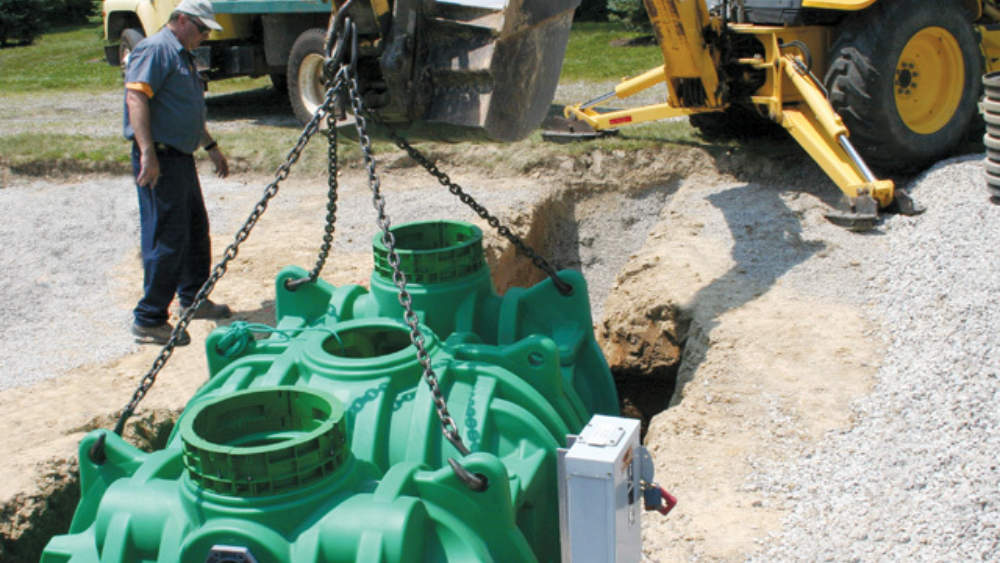
The Singulair Green aerobic wastewater treatment system from Norweco Inc. features a light, versatile high-density polyethylene septic tank that’s suitable for installation applications where traditional tanks cannot be used.
“These tanks do not require specialized equipment, like a boom crane, to install and deliver, because the unit weighs just less than 1,000 pounds,” says Mike Benton, sales manager for Norwalk, Ohio-based Norweco. “All an installer needs is a utility trailer big enough to haul the tank and a mini-excavator. It’s a great tool for opening up new markets for installers.”
Suitable for new and retrofit applications, the Singulair Green features 1,300-gallon capacity and can treat up to 600 gallons of wastewater per day, utilizing a three-chamber system. In the first, or pretreatment chamber, material that won’t break down settles to the bottom. In the second, or aeration chamber, an aerator introduces oxygen into the wastewater, which creates a favorable atmosphere for bacteria growth.

Four international plumbing and building codes have adopted the NSF/ANSI 350 standard for water reuse systems, NSF International said in a press release.
The global public health organization developed NSF/ANSI 350: Onsite Residential and Commercial Water Reuse Treatment to standardize the material, design and performance criteria for water reuse systems.
These systems treat greywater on-site, providing an additional source of water for restricted indoor use and reducing the strain on municipal resources, particularly in areas such as California where water scarcity is a growing concern.
“Water scarcity is a growing global issue and ensuring certified water reuse systems properly treat greywater will be an essential part of the solution,” commented Jessica Evans, director of Standards Development at NSF International.